The Story of the Corby Trouser Press
1. Introduction: The Mystery of the Wooden Wall Fixture
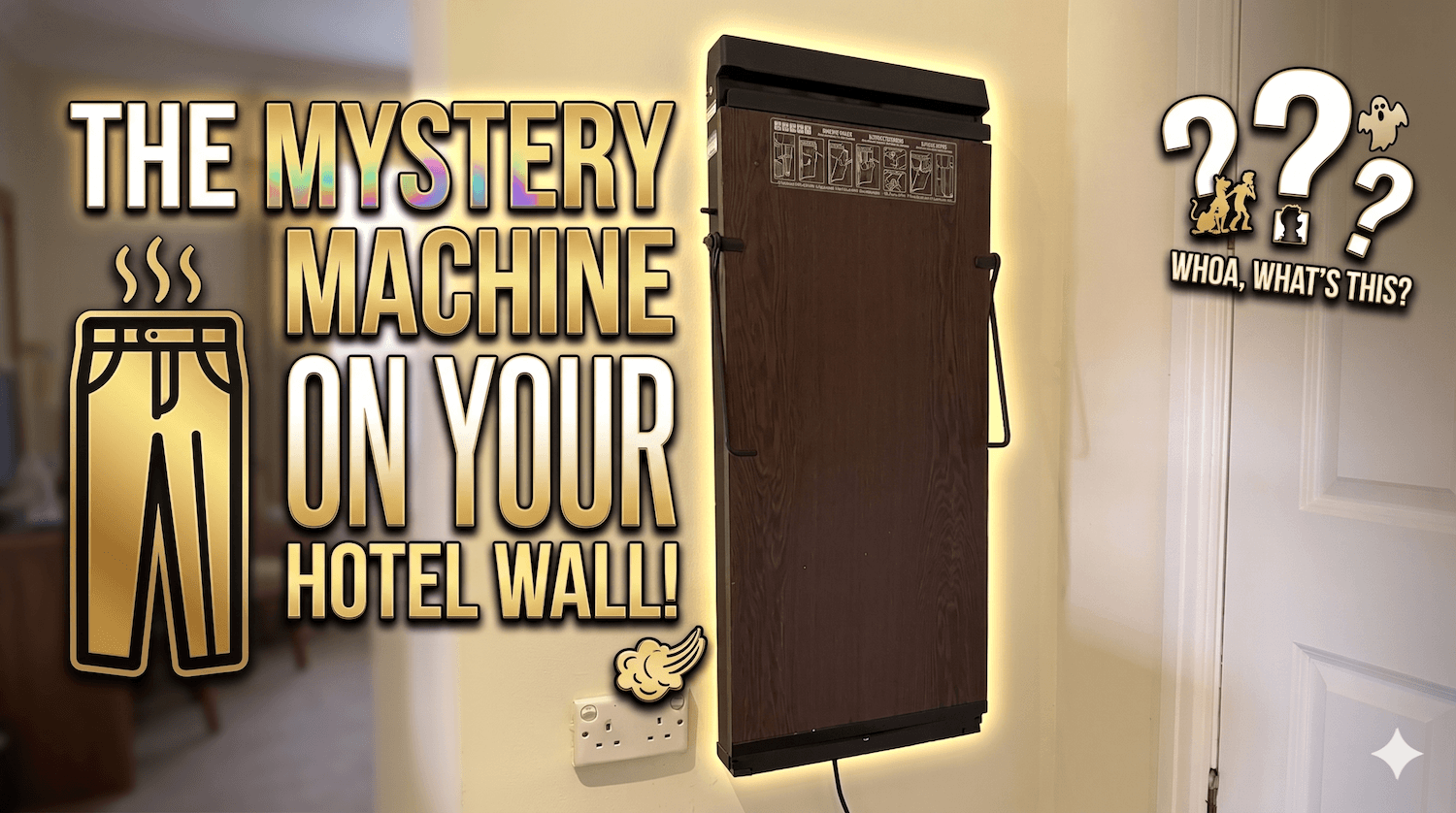
For many a weary traveller entering a hotel room across the United Kingdom or continental Europe, the encounter is almost ritualistic. One drops the luggage, scans the mini-bar, and then pauses before a curious, vertical fixture mounted to the wall or standing stoically on two sturdy feet. To the uninitiated, this slim, wood-effect cabinet looks like a redundant piece of retro-futurism or perhaps a very narrow cupboard.
In truth, this is the Corby Trouser Press. For over half a century, it has served as a hallmark of refined hospitality, designed to provide a crisp, professional crease to a gentleman’s suit without the cumbersome requirement of a traditional iron. While it may appear to be a relic in our era of “athleisure,” the story of this eponymous brand is a masterclass in British engineering and a fascinating intersection of domestic convenience and supersonic aeronautical technology.
2. The Mechanical Beginnings: John Corby and the 1930s
The history of the brand began not in a factory, but in the mind of John Siddons Corby. He arrived in Windsor from his native Scotland in 1929, initially serving as a business consultant at 6 Frances Road. A man of keen entrepreneurial spirit, he soon established John Corby Limited in 1930, focusing on the production of high-quality valet stands.
The first true trouser press emerged in 1931. Interestingly, the prototype was a mechanical, non-electric device that John had cleverly fitted inside his own wardrobe door. The invention might have remained a personal eccentricity had it not been for a chance encounter with Austin Reed, the prominent figure behind the famous chain of gentleman’s outfitters. Impressed by the device, Reed suggested that a free-standing version would be a commercial triumph. To John’s astonishment, Reed placed an initial order for 72 units, effectively launching the company.
Initially, manufacturing was a fragmented affair; the metal parts were stamped out at 28 Frances Road in Windsor, while the woodwork was sourced from High Wycombe. However, by 1935, sales had exceeded 5,000 units annually, prompting John to consolidate the entire manufacturing process—woodwork included—at the Frances Road site.
3. The Electric Revolution: Peter Corby and the Concorde Connection
The company’s trajectory changed significantly when John’s son, Peter Corby, joined the firm in 1939. His tenure was briefly interrupted by service as an RAF flight engineer during the Second World War, but he returned to the family business in 1949 at a salary of £1,000 a year. By the 1950s, however, the brand faced an existential crisis. The advent of crease-resistant materials rendered traditional mechanical presses largely ineffective, and sales began a precipitous slump.
To keep the factory afloat, the firm diversified, producing cots for Mothercare and garden furniture for Sutton Seeds. The “Eureka moment” arrived in the 1960s when Peter Corby met an aeronautical engineer working on the Concorde supersonic aircraft. The engineer had developed a specialized heating system designed to prevent the Concorde’s nose cone from freezing at high altitudes.
Peter realized this technology could be adapted for garment care. Collaborating with the science laboratory at Eton College, the company developed a flexible heating pad capable of reaching 60°C (140°F). While industry veterans were initially sceptical—Barry Reed, son of Austin Reed, would only take three units per shop on a “sale or return” basis—the electric press was a sensation. Within a year, Harrods alone sold over 1,500 units, and the modern Corby was born.
4. Engineering the Perfect Crease: How it Works
Unlike a standard iron, which can impart a tell-tale “surface shine” on fabrics, the Corby press utilizes a gentle combination of thermals and pressure. The engineering is specifically designed to preserve the “hang” and integrity of high-quality trousers.
Unique Features
- Tension-sprung base: This section adjusts its pressure automatically based on fabric thickness, ensuring a uniform finish regardless of the material.
- Cushioned heating pad: The padding allows the press to accommodate raised seams and fabric pile without flattening them into the garment.
- Stretchers: These are critical; they grip and “ease” the trousers into the correct shape before heat and pressure are fully applied, ensuring the garment returns to its original silhouette.
Model Comparison
| Model | Timer Cycles (Minutes) | Special Features |
|---|---|---|
| Corby 3300 | 30 | Standard entry model; wood-effect finish. |
| Corby 4400 | 15, 30 | Mid-range with dual timing options. |
| Corby 6600 | 15, 30 | Dual-function: features a fold-out ironing centre. |
| Corby 7700 | 15, 30, 45 | High-performance with three cycles. |
| Statesman | 15, 30 | Classic styling for traditional suites. |
| Executive | 15, 30, 45 | High-gloss black panel; modern aesthetic. |
5. Operating the Legend: A Step-by-Step Guide
To achieve the crisp result expected of a British gentleman, one must follow the proper protocol.
- Safety First: Ensure all pockets are emptied of keys, coins, or sharp objects that could puncture the heating pad.
- Critical Warning: On no account should any trousers be dampened before pressing. The machine relies on the inherent humidity of the fibers.
- Positioning: Raise the lever arms and insert the trousers “feet first” into the base.
- Alignment: Smooth the fabric carefully, ensuring the existing creases are perfectly aligned.
- The “Ease”: Firmly grip the top of the trousers and pull slightly upward while closing the front board to let the stretchers do their work. Push down the lever arm to lock.
- Cycle Selection: Natural fibers (wool, cotton) press beautifully due to their humidity; man-made fibers like polyester may require a longer 45-minute cycle.
6. Why Every Hotel Had One: The Golden Age
During the peak of international business travel, the trouser press was the ultimate sign of “thoughtful care.” It allowed the travelling professional to maintain a sharp appearance for morning meetings without the indignity of wrestling with a hotel iron.
By 1973, production reached a staggering 80,000 units per year. The device became a standard room feature for the world’s most prestigious chains, including Hilton, Marriott, and Intercontinental. It wasn’t merely a machine; it was a symbol of an era where hospitality was defined by the small, delightful details that anticipated a guest’s every need.
7. The Modern Decline: Why the Machines are Vanishing
Despite its heritage, the Corby press is increasingly becoming a rarity. Several cultural and technological shifts have contributed to its withdrawal:
- Casual Dress Codes: The rise of “Casual Wear” and the decline of the formal suit in business settings have diminished the daily demand for a sharp crease.
- Technological Alternatives: Handheld steamers and the ubiquity of high-quality steam irons offer faster, if less specialized, results.
- Convenience Culture: Modern hotel design often favors minimalist, neutral aesthetics over specialized wall fixtures.
The brand has also seen structural changes. The Andover factory, which had been the company’s base for years, closed in 2005. In 2009, John Corby Limited was acquired by the Fired Up Corporation, which moved production to Huddersfield, where it continues to manufacture these iconic devices today.
8. Cultural Legacy and Conclusion
The Corby Trouser Press has carved out a permanent niche in British cultural history. It is famously a point of obsession for the fictional broadcaster Alan Partridge, and it was famously parodied by the Bonzo Dog Doo-Dah Band in their song “Trouser Press”—a title so evocative it became the namesake for the renowned US music journal.
Ultimately, the Corby remains a testament to the belief that details matter. It is a piece of design history that transitionally linked the golden age of valet service to the modern era of self-sufficiency.
Have you ever successfully mastered the Corby press during your travels, or do you view it as a charming relic of a more formal age? Share your memories of this classic hotel fixture below.